

Table of Contents
Toggle“Hole in a Child’s Heart: Symptoms, Causes, and Modern Non-Surgical Treatments” – a Guide from group of Child Heart Doctor in India
Introduction
A “hole in the heart” is a common way of describing certain congenital heart defects in children. Although the term can sound frightening to parents, many heart holes are small and may close on their own. Others may need regular monitoring, medication for symptoms, or a procedure to prevent future complications. Three common conditions associated with the term “hole in the Child’s heart” are Atrial Septal Defect (ASD), Ventricular Septal Defect (VSD), and Patent Ductus Arteriosus (PDA). Depending on the type, size, location and effect on the heart and lungs, some children can be treated using catheter-based procedures without open-heart surgery. For families looking for a child heart doctor for Hole in a Child’s Heart Treatment, early evaluation by a pediatric cardiologist can help determine whether the defect needs observation or treatment.What Is a Hole in a Child’s Heart?
A child’s heart normally has walls and blood vessels that keep oxygen-rich and oxygen-poor blood moving through the correct pathways. When an abnormal opening or connection remains, blood may flow in an unusual direction. An ASD is an opening between the upper chambers of the heart, while a VSD is an opening between the lower chambers. PDA is different because it involves a blood vessel called the ductus arteriosus that normally closes after birth but remains open in some children. The effect of the defect depends largely on its size and the amount of extra blood flowing through the lungs. Small defects may cause few or no symptoms, whereas larger defects can make the heart and lungs work harder.Symptoms of Hole in a Child’s Heart
Some children with ASD, VSD or a small PDA may appear completely healthy. In many cases, the condition is discovered when a doctor hears an unusual heart murmur during a routine examination. However, larger defects may cause signs that parents should not ignore. Common Symptoms of Hole in a Child’s Heart- Fast or difficult breathing
- Frequent tiredness
- Poor feeding in babies
- Sweating while feeding
- Slow weight gain
- Getting tired easily during play or physical activity
- Frequent respiratory problems in some children
- A heart murmur detected during examination
- In more serious cases, signs related to increased pressure in the lungs
Causes for Hole in a Child’s Heart
ASD, VSD and PDA are generally congenital conditions, meaning they develop before or around birth. In many children, the exact reason why a particular defect develops is not known. For ASD and VSD, genetic factors can sometimes play a role, but most individual cases do not have one clear cause. In the case of PDA, the ductus arteriosus is a normal fetal blood vessel. It usually closes after birth, but it may remain open, particularly in premature babies. Parents should remember that discovering a congenital heart defect does not necessarily mean that something was done incorrectly during pregnancy. In many cases, there is simply no identifiable cause.ASD, VSD and PDA: What Is the Difference?
Atrial Septal Defect (ASD)
ASD is a hole in the wall between the two upper chambers of the heart. A small ASD may cause no noticeable problem, while a larger one can result in extra blood flow to the lungs and place additional workload on the right side of the heart.Ventricular Septal Defect (VSD)
VSD is a hole between the two lower chambers. A small VSD may cause only a murmur and may close naturally. Larger VSDs can cause increased blood flow to the lungs and may result in breathing, feeding and growth problems.Patent Ductus Arteriosus (PDA)
PDA occurs when the fetal ductus arteriosus remains open after birth. A small PDA may produce no symptoms, while a larger PDA can increase blood flow to the lungs and put extra strain on the heart and lungs.How Is a Hole in a Child’s Heart Diagnosed?
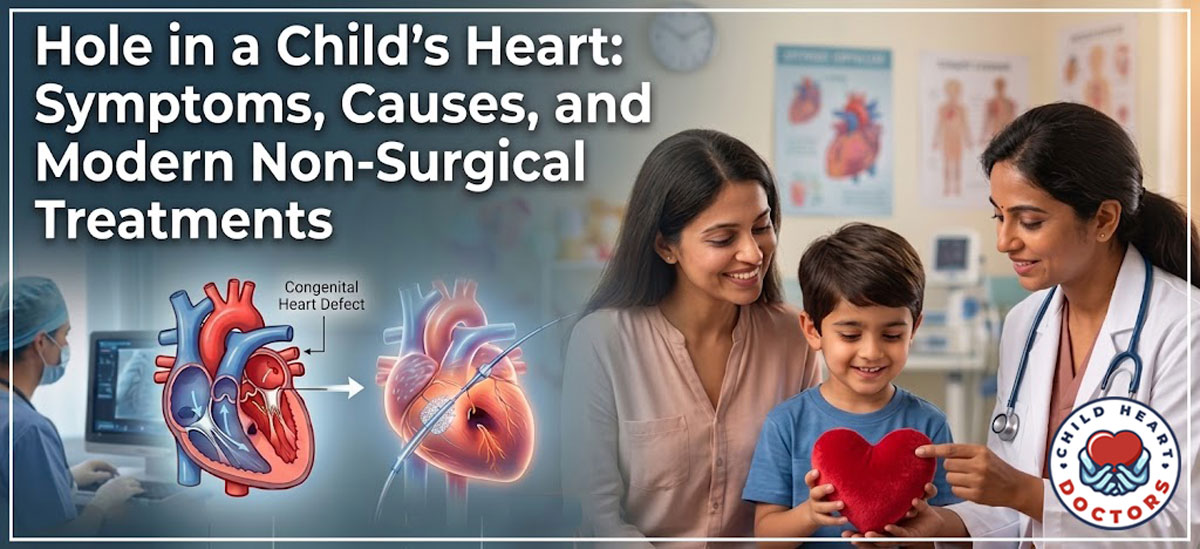
A pediatric cardiologist usually combines the child’s medical history, physical examination and heart tests to understand the condition. Common Heart Tests for Children may include: Echocardiography: An echocardiogram uses ultrasound to create pictures of the heart and helps identify the type, size and location of the defect. Electrocardiogram (ECG): This records the heart’s electrical activity and may provide additional information about the heart’s function. Chest X-ray: In selected cases, it may help assess the heart and lungs. Cardiac catheterization: In some children, catheterization may be used for detailed assessment or as part of treatment. Therapeutic catheterization can allow doctors to repair certain heart defects without opening the chest. The decision to treat depends on several factors, including the child’s age, general health, defect size and location, heart chamber enlargement, blood flow and pressure in the lungs. Do All Heart Holes Need Treatment? No. Not every heart hole needs immediate treatment. Some small ASDs, VSDs and PDAs may close naturally or remain small enough to require only observation. For example, small ASDs and VSDs may not cause symptoms, while small PDAs can also close without an intervention in some children. When the defect is large or causes significant extra blood flow, enlargement of heart chambers, symptoms or rising pressure in the lungs, treatment may be recommended. This is why parents should not decide on treatment based only on the phrase “hole in the heart.” A detailed pediatric cardiology evaluation is essential. Modern Non-Surgical Treatments for Hole in a Child’s Heart Advances in pediatric cardiology have made it possible to treat selected ASD, VSD and PDA cases through minimally invasive catheter procedures. These are often called device closure procedures or interventional cardiac catheterization. Instead of opening the chest, the cardiologist passes a thin flexible catheter through a blood vessel, usually from the leg, and guides it toward the heart. A specially designed device can then be positioned to close the abnormal opening or vessel.Modern Non-Surgical Treatments for ASD/VSD/PDA Device Closure
ASD Device Closure
For suitable ASDs, especially certain secundum ASDs with appropriate anatomy, a closure device may be delivered through a catheter and placed across the opening. The device is designed to seal the abnormal opening and reduce the unwanted blood flow between the atria. Not every ASD is suitable for device closure. The anatomy and surrounding structures must be carefully assessed before choosing this approach.VSD Device Closure
Some selected VSDs can also be closed through a catheter-based procedure. However, whether a VSD is suitable for device closure depends heavily on its location, size and relationship with nearby heart structures. Some children with large or unsuitable VSDs may still require surgical closure.PDA Device Closure
Many children with a PDA can have the abnormal blood vessel closed through catheterization. A small closure device is guided through a blood vessel and positioned to block the PDA. For children who are suitable candidates, this approach can avoid an open chest operation. Benefits of Catheter-Based Device Closure For an appropriately selected child, a catheter-based procedure may offer several advantages compared with open surgery:- No large chest incision
- No need to open the heart
- Less surgical trauma
- Usually a shorter hospital stay
- Faster return to normal daily activities after recovery
- No surgical scar across the chest
Choosing the Right Child Heart Doctor for ASD/VSD/PDA Treatment
Choosing the right specialist is an important decision for parents. Look for a pediatric cardiology team with experience in diagnosing congenital heart defects and performing catheter-based interventions in children. Families searching for a Best child heart doctor team for ASD/VSD/PDA device closure in Kolkata should consider the team’s experience with pediatric echocardiography, cardiac catheterization, device closure and management of complex congenital heart conditions. For families in Howrah, consulting a child heart doctor for ASD/VSD/PDA Treatment of child in Howrah can make access to specialist assessment and follow-up more convenient. An experienced Interventional Cardiologist in Howrah can evaluate whether catheter-based treatment is appropriate and explain the benefits and limitations of the procedure. Parents looking for ASD/VSD/PDA Treatment in West Bengal should also make sure the child receives individualized treatment based on the exact heart defect rather than relying on a general treatment plan.When Should Parents Consult a Pediatric Cardiologist?
Parents should seek specialist evaluation when a child has a persistent heart murmur, unexplained breathing difficulty, poor feeding, poor weight gain, unusual tiredness or other signs that may suggest a heart problem. A pediatric cardiologist can determine whether the symptoms are related to a heart defect. A diagnosis of ASD, VSD or PDA does not automatically mean that a child needs surgery. Modern pediatric cardiology offers several treatment options, including observation, medical support when needed, catheter-based device closure and surgery for selected cases. Final Thoughts A hole in a child’s heart can sound alarming, but many children do very well with timely diagnosis and appropriate treatment. The most important step is understanding the type of defect and how it is affecting the child’s heart and lungs. Today, Modern Non-Surgical Treatments for ASD/VSD/PDA device closure offer an important option for selected children. Catheter-based procedures can close certain defects without opening the chest, while surgery remains an effective option when device closure is not appropriate. For families seeking a child heart doctor for Hole in a Child’s Heart Treatment, early consultation with an experienced pediatric cardiologist can provide clarity about diagnosis, treatment options and long-term follow-up.you suspect your child has a heart issue, do not wait. Early diagnosis often leads to the best outcomes. Use the direct helpline (+91) 91630 48066 today to get an appointment, and take the first critical step toward healing your child’s heart.
Disclaimer: This article is for informational purposes only and does not constitute medical advice. Always consult with a qualified cardiac specialist for diagnosis and treatment related to your personal health condition.
Read Also:
- Child Heart Doctors in Assam in 2025: An Inside View
- Dr. Jayita Nandy Das: Child Heart Doctor – Clinics, Availability, & Consultation Fees
- Get an appointment at Narayana Superspeciality Hospital, Howrah for a pediatric heart doctor: Procedure, Fees, Doctors
- How to Get Best Heart Doctors for Children in Howrah 2026
- Dr. Anwesha Mukherjee: Child Heart Doctor Appointment, Clinics, Availability & Consultation Fees
- List of Eminent Pediatric Cardiologists in Narayana Hospital Howrah in 2026
- A Complete Guide to Pediatric Heart Care in Howrah and Surrounding Areas
- Dr. Rishika Mehta: Child Heart Doctor Appointment, Clinics, Availability & Treatments
- Interventional Cardiology Procedures in Children: Explained by A Howrah Child Heart Specialist
- Specialized Heart Tests and Diagnosis for Your Child in Howrah
- The Best Pediatric Cardiologists in Howrah for Complex Cases
- Pediatric Interventional Cardiologist in Howrah, West Bengal
- Advanced Care for Pediatric Heart Failure: Insights from a Child Heart Expert in Howrah
- Common Acquired Heart Conditions in Children
- Understanding Pulmonary Arterial Hypertension (PAH) in Children
- A Guide to Interventional Cardiology Procedures by Child Heart Specialist in Howrah
- Complete Guide to Congenital Heart Disease Care in Kolkata 2026
- Fetal Echocardiography Test in Howrah: Purpose, Procedure, and Risks